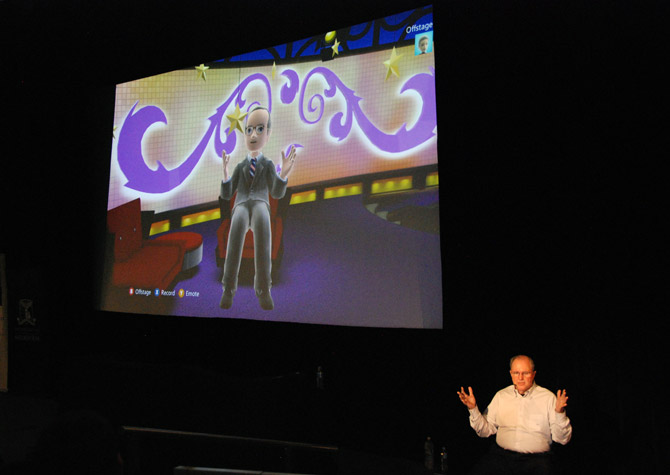
At a public lecture hosted by Melbourne University’s Institute for a Broadband-Enabled Society this evening (which just received Microsoft funding), Microsoft’s Chief Research and Strategy Officer, Craig Mundie gave one of the first public demonstrations of Avatar Kinect after its initial debut at CES 2011.
During his talk on the topic of natural user interfaces called “More Like Us: Computing Transformed”, Craig summarized natural user interfaces as computing without the learning curve. Of course it wouldn’t be a talk about NUIs without mentioning the commercial success that is Kinect.
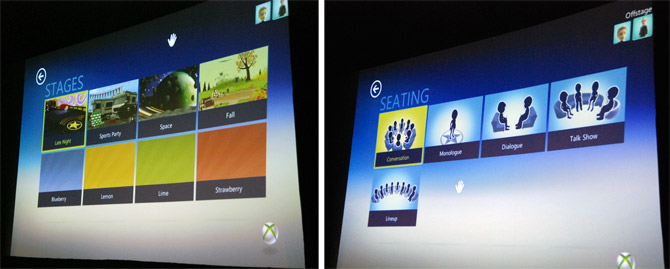
To help illustrate an example of a more natural telepresence experience for more than two people, Craig demonstrated the upcoming Avatar Kinect service with a staff from the university with a walkthrough of some of the stages and seating set ups as well.
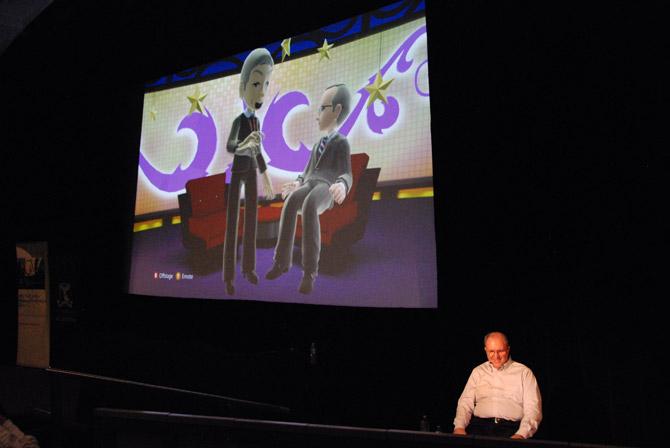
Since it wasn’t final code, a few visual gags (ex. unnatural mouth expressions) got a few laughs, but for the most part it works as advertised.
Looking to the future, Craig suggested one day avatars could be photorealistic but raises questions about whether we would actually want them.
For example, in bandwidth-limited environments like mobile which could one day also have depth sensors built in alongside the camera, charactures present significant advantages as it only requires highly efficient voice and animation data streams.
Finally, Craig anticipates huge uptake of the Kinect Research Development Kit to be released in the “coming months”. Compared to the “Kinect hacks”, Craig comments it abstracts many of the higher level functions into libraries including the array microphone to encourage people to explore the wide applications of the technology. A separate commercial-oriented professional development kit is also on schedule soon after.
Update: Found a video of Craig’s Avatar Kinect demo recorded by Paul Tagell.
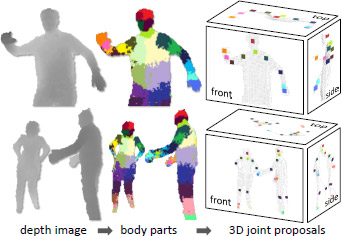 Whilst acknowledging previous work in the field, one area the research team focused to improve was per-frame initialization. That is, the system can work without a lengthy “set-up” phase for the user.